From dusty case files to dynamic data flows, AI is reshaping how legal work gets done – quietly, powerfully, and irreversibly. Here is a readiness checklist you can use to assess whether your firm is built for what is next.
Overview :
- Infrastructure & Data Preparedness: Building the Ground Floor
- Workflow Digitalisation: From Paper Trails to Data Flows
- Talent & Training: People Before Platforms
- Ethical, Legal & Regulatory Readiness: Guardrails for Innovation
- Change Management & Leadership: The Human Side of Transformation
- Client Experience & Value Creation: The Real Measure of AI Success
- Integration & Scalability: Avoiding the “Pilot Trap”
- Financial & Strategic Readiness: From Experiment to Investment
- Cultural Readiness: From Tradition to Transformation
- The AI Readiness Checklist
- Conclusion
The AI Readiness Checklist for Law Firms: A Practical Guide to AI Adoption
-

Vani Sriranganayaki
-
-
Nov 12, 2025
-
16 min Read
-
Across the global legal sector, the conversation around Artificial Intelligence (AI) has shifted from ‘if’ to ‘when’. Law firms, once grounded in precedent and paper, are now facing a future shaped by data, automation, and digital decision-making. AI’s arrival is not a distant prospect; it is already here – embedded in contract analysis, e-discovery, due diligence, and even predictive legal analytics.
But adopting AI is not simply about installing software or subscribing to a tool. It is a cultural, procedural, and ethical recalibration that tests a law firm’s readiness on multiple fronts.
To make matters simpler, this article offers a comprehensive AI Readiness Checklist – a structured way for law firms of any size to evaluate whether they are truly prepared to harness AI effectively. Whether you are a boutique practice taking first steps towards digitalisation or a multinational firm exploring advanced automation, the first step always involves self-awareness and self-assessment.
Infrastructure & Data Preparedness: Building the Ground Floor
AI thrives on data. Before any model can assist in legal reasoning, automate reviews, or predict outcomes, it must first access accurate, secure, and well-structured data.
Ask yourself:
- Do we have a centralised digital document repository, or are case files still scattered across drives, inboxes, and folders?
- Are our documents machine-readable – properly indexed, searchable, and tagged?
- Is client data encrypted, and do we have clear policies on data retention, sharing, and deletion?
Readiness indicators:
- A unified case management or document management system (DMS) in place.
- Cloud or hybrid infrastructure with robust cybersecurity protocols.
- Clean, labelled, and structured datasets ready for machine learning or analytics integration.
Firms lacking this foundation risk building on sand. AI tools depend on the consistency and integrity of data – an overlooked metadata field or missing label can distort outputs and compromise confidentiality. Modern AI-ready platforms are designed to handle this early stage seamlessly – enabling document digitisation, tagging, and metadata enrichment that set the stage for intelligent automation.
Workflow Digitalisation: From Paper Trails to Data Flows
AI cannot improve what is not defined. Many firms find themselves in a loop of manual, unstructured work – reviewing, approving, filing, e-mailing – with no clear process map. Before introducing automation, firms must first understand and standardise their workflows.
Ask yourself:
- Have we mapped our key workflows (e.g., client intake, contract review, case preparation)?
- Do we have digital touchpoints or are there still manual dependencies (signatures, approvals, scanning)?
- Can we identify repetitive, time-intensive tasks that yield predictable outcomes?
For example, consider automating initial case triage – routing new client enquiries to the appropriate department using predefined logic. Or digitising contract review with AI-assisted clause detection. The rule of thumb here is:
‘If you can define it, you can digitise it. If you can digitise it, you can automate it.’
Once processes are clear, AI can amplify them – reducing friction, improving efficiency, and freeing legal minds to focus on higher-value strategy and advocacy.
Talent & Training: People Before Platforms
AI transformation is ultimately a people story. Legal professionals need not become data scientists, but they must understand enough about how AI works to use it responsibly and effectively.
Start with reflecting on your team’s readiness:
- Are lawyers, paralegals, and clerks trained in the basics of digital tools and data ethics?
- Do we have internal champions or ‘AI stewards’ who can bridge the gap between law and technology?
- Is there a culture of continuous learning and experimentation within the firm?
Firms that treat AI as a supplement to human judgment – not a substitute – will build healthier, more adaptive teams. Upskilling initiatives, workshops, and cross-functional learning can demystify AI and ensure collective ownership of transformation. As many in the legal tech community point out, ‘AI does not replace the lawyer – it replaces the lawyer who refuses to learn AI.’
Ethical, Legal & Regulatory Readiness: Guardrails for Innovation
The legal profession is built on trust, confidentiality, and accountability – all of which must remain intact even as automation enters the workflow. Before deploying any AI system, firms must consider certain ethical and compliance boundaries:
- Are client data and communications handled in accordance with privacy laws (e.g., India’s Digital Personal Data Protection Act, Europe’s GDPR, etc.)?
- Can we explain how AI systems arrive at their conclusions? Transparency is non-negotiable.
- Who owns the outputs – the firm, the AI provider, or the client?
- Have we developed internal AI ethics guidelines or usage policies?
This is what readiness looks like in practice:
- Legal, compliance, and IT collaborate closely from day one.
- Transparent AI systems that come with built-in audit trails and explainability.
- Continuous risk checks that catch bias, protect data integrity, and safeguard client confidentiality.
For firms operating internationally, aligning with emerging frameworks like the EU AI Act will further strengthen credibility. Those that invest early in governance will gain trust, mitigate risk, and lead with confidence in an increasingly regulated environment.
Change Management & Leadership: The Human Side of Transformation
AI integration is not a ‘switch-on’ project; it is a phased change journey. Leadership plays a decisive role in making this change both aspirational and manageable. Ask yourself if your firms are truly ready for AI, organisationally speaking.
- Has your firm leadership clearly articulated why AI adoption matters?
- Are partners and senior associates visibly supportive of pilot projects?
- Are communication channels open for feedback, resistance, or innovative ideas from all levels?
Firms that answer yes, often operate with well-established AI task forces or digital transformation committees to steer the process – ensuring alignment between business strategy and technology adoption. It is important to keep in mind that change fatigue can derail the best-intentioned initiatives. Regular updates, transparent discussions about outcomes, and celebrating small wins keep the team engaged and invested. Afterall, AI readiness is as much about mindset as it is about mechanics.
Client Experience & Value Creation: The Real Measure of AI Success
At the end of the day, AI adoption must translate to better client outcomes. Whether it is faster turnaround times, more transparent billing, or data-driven insights, clients must feel the benefit. Just answer these questions to check client-facing readiness:
- Do our clients know how we are using AI to serve them better?
- Can we communicate the advantages – accuracy, speed, consistency – without overselling automation?
- Are we using AI insights to anticipate client needs and improve relationships?
AI offers an opportunity to reimagine client engagement. For instance, predictive analytics can identify litigation risks or likely case durations. Contract automation can accelerate onboarding. Virtual assistants can keep clients informed around the clock. But trust remains the anchor. Clients will reward firms that combine the precision of technology with the empathy of human counsel. Solutions like Justice Accelerator and other AI-driven legal innovation platforms demonstrate how technology can elevate – not replace – the human element at the heart of legal practice.
Integration & Scalability: Avoiding the “Pilot Trap”
Many firms start their AI journey with scattered pilot projects – contract review in one corner, e-discovery in another – but hit a wall when trying to scale. What they fail to realise is that integration is the bridge between experimentation and transformation. The best way to check for integration and scaling readiness is to ask:
- Do existing systems (CRM, billing, DMS) integrate with planned AI tools?
- Have we identified redundancies or overlaps in software investments?
- Is there an internal team or vendor partner accountable for end-to-end deployment?
Integration is not just technical, it is operational. When AI outputs feed seamlessly into human workflows, efficiency compounds. Start small, validate success, and scale responsibly with defined KPIs. A well-integrated AI ecosystem also future-proofs the firm – allowing modern technologies (generative AI, predictive analytics, voice assistants) to plug in without friction.
Financial & Strategic Readiness: From Experiment to Investment
Adopting AI demands a realistic view of cost versus value. Beyond software licensing, expenses include data cleaning, staff training, process redesign, and maintenance. Firms ready to invest strategically will:
- Develop a clear business case linking AI outcomes to measurable ROI (billable hours saved, client retention, accuracy gains).
- Pilot tools in high-impact, low-risk areas before full rollout.
- Align technology budgets with firm-wide strategic objectives rather than ad-hoc purchases.
Smaller firms always have the option to begin with modular tools – document automation, chatbots, or analytics dashboards – and expand gradually. What matters is not how advanced your tech stack is, but how well it supports your firm’s long-term goals.
Cultural Readiness: From Tradition to Transformation
Legal practice is deeply cultural – shaped by precedent, hierarchy, and convention. For AI adoption to succeed, the firm’s culture must evolve to embrace curiosity, experimentation, and collaboration.
- Teams must be open to trying new tools without fear of failure.
- Mistakes must be seen as learning opportunities rather than risks to reputation.
- Partners must encourage innovation, even in billable environments.
Cultural readiness is where the intangible becomes decisive. A firm’s values, communication style, and appetite for change often determine whether AI remains a novelty or becomes a natural extension of its identity.
The AI Readiness Checklist
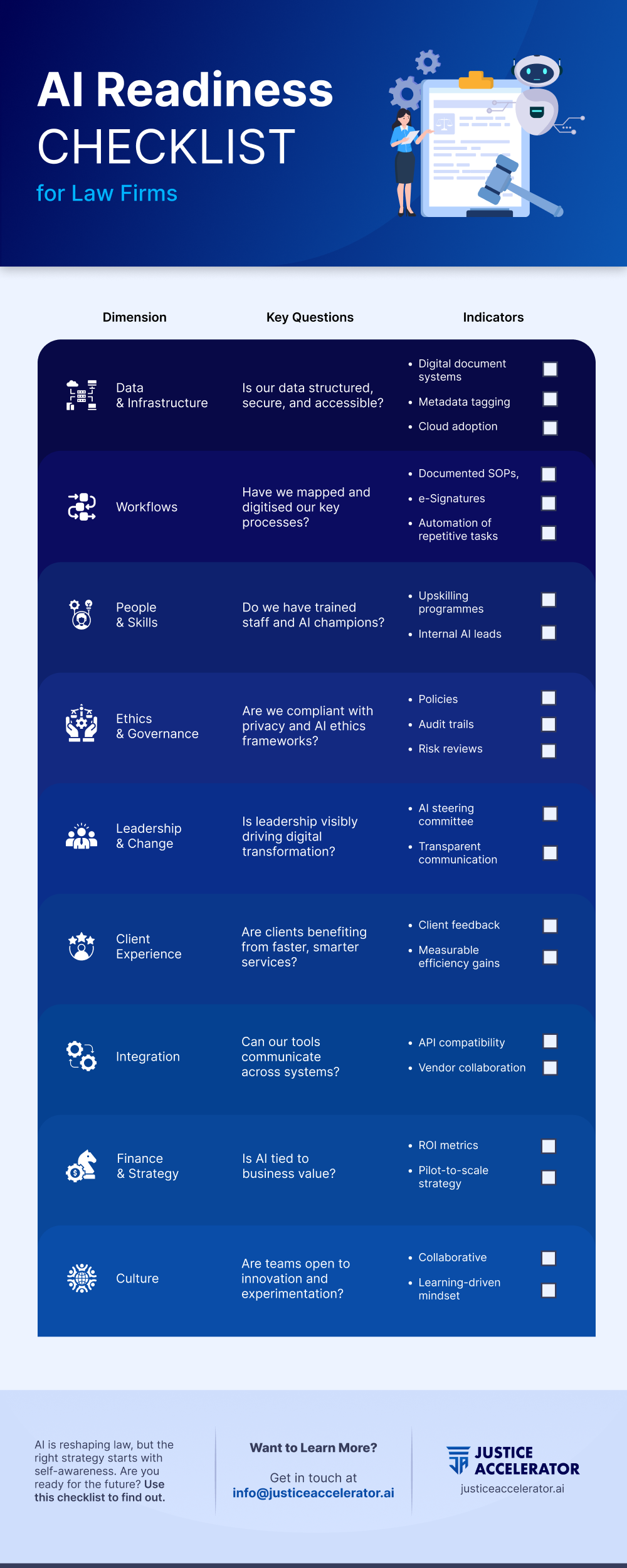
Before diving into strategy or tech investments, it is crucial to know where you are starting from – and where the gaps might be. With that in mind, here is a pared-down version of the full readiness matrix – a quick lens to self-assess where your firm stands and understand where you want to be:
Conclusion
AI is not an endpoint – it is a continuum of learning, adaptation, and reinvention. The firms that will thrive are those that see AI not as a technology project, but as a strategic evolution in how they deliver value, uphold ethics, and earn trust. The legal world is, by nature, cautious – and rightly so. Yet caution need not mean hesitation. AI offers the profession an opportunity to return to its essence: insight, advocacy, and impact. As these tools mature and regulation finds its rhythm, those who begin their AI readiness journey today will not just be ready for the future – they will write it.
-
Topics:
-
-
Vani Sriranganayaki
Writer, editor, and Head of Communications, Vani brings over a decade of expertise in publication and communication to explore the evolving world of technology. She crafts impactful narratives at the intersection of legal innovation and tech, championing progress. Reach her at vani.s@elint.in.




 +971 50 9295048
  +91 9746059514